7 min read
Jul 17, 2026
The product catalogue does not stay straightforward for long. A company that starts with 12 products finds itself dealing with hundreds of SKU variants in a matter of two years. The larger the catalogue, the more products you are supposed to sell. In reality, a larger catalogue brings about increased indecision. Buyers come to a page, compare various product variants, become confused as to what they really need and leave empty-handed.
Product bundling is the way to fix that issue since it is based on grouping products based on the customer’s intent and not any arbitrary categories existing in the backend of the system. Put the right products into bundles, simplify the shopping process, make the products that were invisible before noticeable, eliminate buyer’s doubt about whether they made a right choice or not. If done properly, it will not only increase your sales but also make the customer feel at home.
Key Takeaways

Picture someone buying their first DSLR camera: six camera bodies, fifteen lenses, four tripods, a dozen memory card options, a wall of accessories. For anyone who isn’t already a photographer, that’s not a catalog — it’s a research project. Skincare and fitness equipment have the same issue, with enough variety that sorting through it requires real expertise. Every product might earn its place on the shelf, but laid out individually, they create noise instead of clarity.
This is choice overload, and it doesn’t push people toward more careful decisions — it pushes them to delay the decision entirely. For a brand, that shows up as abandoned carts, weaker e-commerce conversions, and customers who never discovered products they’d have happily bought if the store presented them differently. The catalog isn’t the problem. How it’s presented is.

Nobody shops by SKU. Someone buying camping gear isn’t hunting for a tent, then a sleeping bag, then a lantern — they’re getting ready for a trip. A new parent isn’t browsing “baby products” as a category; they’re trying to cover the essentials for the first few months.
That gap between how a catalog is structured and how people actually think is what product bundling closes:
The store has already worked out what belongs together, so the customer doesn’t have to.
Buying a laptop online rarely stops at the laptop — there’s a sleeve to find, maybe a mouse, a USB hub, a keyboard. Every one of those is a separate search and a separate chance to abandon the cart. Bundles cut that friction by putting related products on the same page as the item someone’s already decided to buy. It’s faster for the shopper, and it gives visibility to items that would otherwise sit buried in a different category — product discoverability working quietly in the background.
The problem with many abandoned checkouts is not about the price but about uncertainty: does the printer contain ink? Do I have to buy filters for the coffee machine? Bundles eliminate the uncertainty because they provide an entire package in one place. It is especially true for first-time shoppers who do not know the brand and cannot make the missing pieces on their own – a bundle becomes a solution thought out in advance.
Some companies fear that the bundling might limit their customer’s choices, but all the products are still available for any combination. Experienced shoppers will be able to immediately start comparing features, while new customers will have an opportunity to choose an already thought-out solution from the start. Providing both options satisfies different types of customers without making any shopping process slower. It is especially important for a Shopify store whose product line expands much faster than the knowledge of customers.

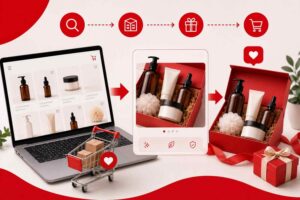
Good landing pages and banner ads receive a lot of consideration; however, merchandising truly begins with how the catalog is structured. Bundles provide for an intuitive experience within it, because it is no longer hundreds of items unrelated to each other, but collections of products that work towards a particular purpose.
This is where product discoverability does real work. A customer buying a yoga mat probably isn’t also searching for resistance bands or a carrying strap — not because they don’t want them, but because it hasn’t occurred to them yet. Put those items in a bundle next to the mat, and they’re visible at exactly the right moment, including slower-moving inventory that gains attention by sitting next to a bestseller.
One of the biggest mistakes in bundling is creating a collection to sell off certain inventory rather than offering a solution to a certain problem. “Work From Home Essentials” bundle (laptop stand, keyboard, mouse, desk lamp); “Weekend Camping Kit” (tent, sleeping bag, stove, lantern); “Daily Skincare Routine” (cleanser, toner, serum, moisturizer, sunscreen) – none of these bundles were built using inventory categories. These were built with purpose in mind, hence, their intuitive design.
The strongest bundle ideas are usually already sitting in the sales reports. Look at what customers consistently buy in the same order — hiking boots with trekking socks and waterproof spray, say — and that combination has effectively already proven itself. This also sharpens cross selling Shopify strategies, since the recommendations feel like an extension of what the customer wanted, not an unrelated pitch.
A bundle that takes several minutes to understand has already failed at its job. A few things help: a name that says exactly what the bundle is for, images showing everything included, a clear sense of who it’s built for, obvious savings, and resisting the urge to add “just one more” item. Clarity beats size — a tight three-item bundle usually outperforms a sprawling one.
“You might like.” “Customers also bought.” “Trending right now.” The more you put of these statements on your webpage, the less consumers will listen to any of them. One bundle is much more subtle than ten competing recommendations — one recommended pairing versus ten competing ones. In this way, it looks like an advice rather than a suggestion, which is particularly important for big catalogs when consumers can be easily distracted from purchasing.
A first draft of a bundle is never going to be the best version of that bundle. Seasons change, new items are introduced, and buying behaviors evolve accordingly. Something worth taking note of: What are your top-revenue-producing bundles? Which are converting well? And which item combinations are frequently bought together but have yet to be bundled?
Once a catalog reaches a certain size, managing these combinations by hand stops being realistic. BundleSuite helps Shopify merchants build Shopify product bundling experiences without the manual upkeep — starter kits, premium collections, or bundles pulled straight from buying patterns — organizing a catalog the way customers actually shop rather than the way a spreadsheet is organized.

An increase in the number of products in the catalog should help the business but not complicate shopping for consumers. The customer does not come in search of a product list but comes to achieve a certain purpose. Product bundling makes the long disconnected list of products the complete solution to the customer’s purpose, improving product discoverability, reducing choice overload, and boosting the customer’s confidence enough to make the purchase without doubt. In turn, this leads to higher ecommerce conversion rates and efficient cross selling Shopify practices.
BundleSuite is your Shopify-ready bundle builder app for high-converting bundles—BYOB, Mix & Match, Volume Discounts, Kits, Combos, you name it.
Built for merchants who want control, flexibility, and results. BundleSuite is your Shopify-ready bundle builder app for high-converting bundles—BYOB, Mix & Match, Volume Discounts, Kits, Combos, you name it. Built for merchants who want control, flexibility, and results.
BundleSuite is your Shopify-ready bundle builder app for high-converting bundles—BYOB, Mix & Match, Volume Discounts, Kits, Combos, you name it. Built for merchants who want control, flexibility, and results.
Grouping complementary products together and selling them as one package, so customers buy a complete solution instead of piecing one together themselves.
It turns a long, flat catalog into curated collections built around specific needs, so shoppers choose a solution instead of sorting through dozens of items.
Yes — bundles put complementary items in front of shoppers who wouldn’t have searched for them on their own.
It’s built around a customer goal, includes genuinely related products, has a clear name and clear value, and ideally reflects real purchase data.
Yes — tools like BundleSuite handle the ongoing maintenance, so merchants can create and update bundles as the catalog grows without rebuilding combinations by hand each time.
Your email address will not be published. Required fields are marked*