10 min read
Jun 09, 2026
Every Shopify merchant hits the same ceiling eventually. Traffic is stable, conversion rate is acceptable, but revenue per order isn’t moving. The two strategies that address this most directly are cross selling Shopify and product bundling Shopify — and most stores use one, use the other badly, or conflate them entirely. They’re not the same thing.
They work through different psychological mechanisms, they suit different catalog types, and they perform differently depending on where a customer is in their buying journey.
This blog provides a description of everything that the different strategies effectively accomplishes, the AOV impacts compared to the other methods discussed in this report and the ideal time to execute each of the strategies along with guidance on how to be able to use both methods of selling without needing multiple tools or processes to accomplish this.
In general, bundling will provide the fastest path to increasing the AOV of your store for the majority of retailers on Shopify while cross selling has a wider range of customers than bundling therefore, the top performing stores will utilize both strategies.
6 things worth knowing before you keep reading:
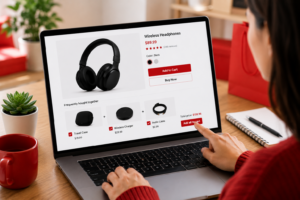
Cross sell Shopify means presenting a customer with a product that complements what they’re already buying or have already bought. They’re buying a camera — you suggest a memory card. They’ve just checked out a yoga mat — you follow up with a block and strap set. The core mechanic is relevance at the point of highest intent.
How to cross sell on Shopify well comes down to three things: placement, relevance, and timing. Most stores get one of the three right.
Placement matters because cross selling Shopify suggestions shown at the wrong point in the journey get ignored. A cross-sell on the homepage is too early — the customer hasn’t committed to anything yet.
A cross-sell after checkout is too late for the same transaction but exactly right for a follow-up email. The product page and the cart are the two most effective placements for in-session cross-sells — close enough to the decision to feel relevant, early enough to influence the order value. Relevance matters because a generic “you might also like” carousel that’s actually just a bestsellers list is not a cross-sell — it’s lazy merchandising wearing a cross-sell label.
The best cross sell app Shopify solutions allow rule-based or purchase-data-driven recommendations: if customer is buying X, show Y and Z. That specificity is what separates a 2% click rate from a 12% one.
Timing matters in the post-purchase context. A cross sell app Shopify that triggers a follow-up recommendation 48 hours after delivery — when the customer has used the product and is in a positive frame of mind — will consistently outperform the same recommendation served at checkout. Shopify cross sell strategy should account for this. Not every cross-sell opportunity exists within the same session. Best Shopify cross sell app tools handle all three variables: placement logic, relevance rules, and timing across email and on-site.
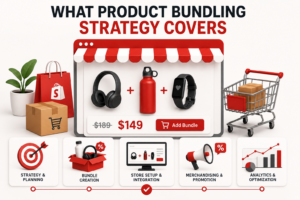
Product bundling Shopify is structurally different from cross-selling in one important way: the decision architecture changes. A cross-sell asks the customer to add something to a decision they’ve already made. A bundle presents a complete decision from the outset — here’s the combination, here’s the price, is this for you?
That difference has consequences for how customers respond to each format. Bundle products in Shopify creates a contained purchase. The customer isn’t evaluating individual products sequentially; they’re evaluating a complete offer. That’s cognitively simpler, which is why well-structured bundles often outperform individual product pages on conversion rate, not just AOV.
Product bundle Shopify formats also work differently on perceived value. A bundle priced at £75 containing products worth £95 individually doesn’t just feel like a £20 saving — it feels like a curated recommendation from a brand that knows what goes together. The curation signal adds value beyond the discount. Cross-sells don’t carry that signal in the same way.
Shopify bundle products that align with real-life, common scenarios — like creating your morning skincare regimen or setting up your office – rank higher than other types of bundles where only the product type was taken into account. This provides context for why a product combination seems to go together rather than just happen to go together. Product bundling strategy should also account for catalog structure. Brands with strong complementarity across their range (every product plausibly goes with at least two others) are better positioned for bundling than brands with a narrow or highly segmented catalog. For the latter, cross sell Shopify mechanics often make more sense as the primary revenue-per-order strategy.
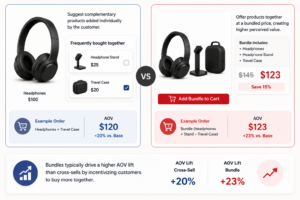
On pure AOV impact, bundling typically wins — but the comparison is more nuanced than it looks.
These aren’t mutually exclusive, but they’re not interchangeable either. Here’s when each format earns its place:
When offering suggestions to customers, you can provide relevance to them and include suggestions based on current inventory but without requiring a bundle purchase. In addition, when using a post purchase time frame to support a customer’s retention strategy. Additionally, there are numerous items available in various categories of your catalog that have excellent individual appeal on their own and will help the customer by adding to the experience if used together.
Product recommendation Shopify placements — specifically on the cart page and in post-purchase emails — are where cross-selling does its best work. The customer has already committed to the transaction. Lowering the activation energy for “one more thing” is a much lighter lift than it is at the start of the session.
Your catalogue is sizable enough to be able to promote bundled offers for all your core combinations and to promote non-core products using cross-sell offers, which is the case for most mid to large Shopify stores. A bundle facilitates a high intent/high value transaction, while a cross-sell captures the incremental opportunity around the transaction.
Best upsell app Shopify integrations that support all three mechanics — bundle, cross-sell, upsell — within a single management interface are worth prioritising. Managing three separate tools for three overlapping strategies creates operational overhead that most teams can’t sustain.
How to cross sell on Shopify and manage bundles simultaneously used to mean juggling multiple apps, inconsistent discount logic, and inventory tracking that broke the moment a bundle SKU sold out. Most cross sell app Shopify solutions handle cross-sells but not bundles. Most bundle apps don’t handle cross-sells. The gap between them is where revenue leaks.
BundleSuite app is built to close that gap. It handles product bundle Shopify formats — fixed bundles, mix and match, kit builders — alongside cross-sell and frequently bought together Shopify recommendation placements, within a single platform.
The practical benefit is that both your bundle discount rules and your cross-sell policies are stored in the same place. So when a product is out of stock, it changes both the bundle/discount configuration and the cross-sell configuration at the same time. So if you are trying to determine if something is raising AOV, you can do so from one dashboard instead of using two separate apps to collect and analyze data.
For stores that are currently running a cross sell app Shopify but haven’t formalised their product bundling strategy — or vice versa — BundleSuite is the more direct path to running both properly. The BundleSuite app setup is straightforward enough that both mechanics can be live within a day, without developer involvement.
Cross selling Shopify and product bundling Shopify are both legitimate answers to the same question: how do you increase revenue per customer without increasing traffic costs? They just answer it at different points in the journey and through different psychological mechanisms. Bundling changes the structure of the decision.
Cross-selling adds to a decision already made. Product bundling strategy wins on AOV per transaction when the catalog supports it. Cross sell Shopify wins on reach and flexibility when it doesn’t. The stores growing revenue per order fastest aren’t debating which one to use — they’re using both, sequenced correctly, measured against the same AOV baseline. The best cross sell app Shopify for most stores is the one that handles bundles too. That’s the setup worth building toward.
If you’re ready to run both strategies on Shopify without the operational overhead of multiple tools, BundleSuite handles bundles, cross-sells, and frequently bought together Shopify recommendations in one place. Worth a look if you’ve been managing these separately.
At first, I was a bit worried since there weren’t many reviews yet, but I can confidently say this is an outstanding app with an amazing development team. There are many similar apps out there, but most of them are expensive and don’t offer a full set of features. This app, on the other hand, is currently free and already includes the functionality I was looking for. I also heard that a bundle duplication feature is coming soon, which shows how quickly the team listens and responds to user feedback.
Your email address will not be published. Required fields are marked*