7 min read
Jul 20, 2026
BOGO is exactly what it sounds like. Buy one, get a second one free, or heavily discounted. Simple mechanic, and that’s precisely why it works so well.
A buy one get one free deal is the most common version, but plenty of stores run a 50% off second item instead, which is really just a softer BOGO sale. Either way, it’s one of the oldest tricks in ecommerce promotions, older than online shopping itself, and it still performs because the math is instantly obvious to a shopper standing in front of it. No calculator needed, no code to remember at checkout.
The psychological aspect of the BOGO offer differentiates it from a flat discount. While a 25% discount is perceived as an actual price cut, BOGO feels like getting something for free instead of just a lower price. People appreciate this difference and that is the reason many BOGO Shopify promotions have better success rates than comparable percentage-off codes in terms of clicks and sales.
Key Takeaways
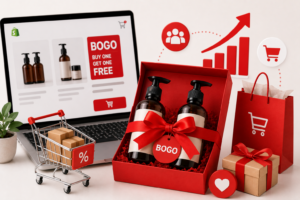
A shopper who wasn’t planning to buy two of anything suddenly is, and the cart total climbs even when the second item is free. That’s a straightforward way of increasing AOV without touching your core pricing.
Pair a bestseller with a slower-moving item as the free half of the deal, and shoppers try things they’d never have picked up on their own. Half the time they come back and buy it again, full price, next month.
BOGO deals travel well. They get screenshotted, shared, and searched for, which makes them one of the more efficient offers for pulling in first-time buyers who were on the fence about a buy one get one deal somewhere else.
Excess stock items lying around the warehouse are surplus. Using a BOGO discount offer on a slow-moving product, along with a popular one, frees up the shelf space without lowering the prices of sought-after products. Underneath all four of these sits perceived value. Shoppers consistently rate a BOGO deal as more generous than a discount of equal dollar value, even when the store’s margin impact is nearly the same either way. That gap between perception and reality is most of the reason BOGO pricing works as well as it does.

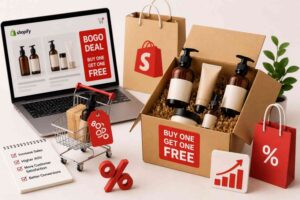
As long as you attach an item that’s been around to a bestseller as the product being offered for “free,” then customers have a risk-free chance to test it out. This concept is about product discovery but dressed as a promotion.
This is where bundling products and BOGO actually intersect. The combo of shampoo and conditioner designed as a buy one get one offer feels like a better deal, without actually being so price-wise.
Bundle offer using a BOGO model gives you a better average order value, as people buy extra items in order to qualify for the offer as opposed to just buying enough to get a discount in general.
Going with BOGO is probably the best option for selling seasonal products as a customer acquisition strategy. The product bundles Shopify stores around Festivus or Christmas holidays will perform better than the regular sale. A well-built product promotion combining bundling and BOGO logic isn’t really two tactics stacked together. It’s one product bundling strategy using BOGO mechanics to make the offer land harder, and it tends to outperform either sales promotion strategies used on its own.
There are five elements that differentiate between a successful BOGO campaign and one that ends up losing revenue without anyone noticing it until the month-end report has been published.
Avoid pairing two popular products. Pairing a bestselling item with something less popular is a good way to avoid sacrificing margin.
Poor formatting leads to refunds and complaints from customers. Be sure to describe promotion terms clearly and in detail.
It is so important to do all calculations before launching a promotion. Eliminating the margins of the best-selling products due to incredibly tempting BOGO pricing won’t signify success.
If a customer has to think a few times whether or not she got the eligible products in the cart, it means that the offer fails.
Watch more than revenue. Return rate, repeat purchase rate, and whether the campaign actually helped increase ecommerce sales beyond what organic traffic would’ve done anyway. Get these five right and the payoff shows up fast: a real buy one get one free promotion tends to boost Shopify sales in the short term while also improving retention customer numbers longer term, since a well-run BOGO often becomes part of a genuinely personalized shopping experience rather than a one-off blast to the whole list.

Most BOGO campaigns don’t fail because the idea was bad.
They fail because of one of four avoidable mistakes-
Ignoring the purchase history of customers means making the same mistakes over and over again. Looking at how items that were previously offered together did in sales over time can help come up with good ideas for future campaigns instead of ignoring this information and repeating the same mistakes over and over again.

Implementing BOGO logic manually in Shopify typically involves combining various discount applications, formulating conditional rules, and praying that all goes seamlessly at the time of purchase. With BundleSuite, all of that is avoided; simply set the product that needs to be purchased, the item that is going to be free or sold at a discount price, and the relevant rules, and the application will take care of the rest at checkout.
It’s one of the more complete product bundling solutions built with BOGO specifically in mind, not bolted on as an afterthought to a generic discount tool. As a Shopify bundle app, it treats a buy one get one free promotion the same way it treats any other bundle: something that needs its own logic, its own tracking, and its own performance data.
For merchants comparing product bundling Shopify apps, this is usually the gap that trips up the cheaper alternatives. BundleSuite is built around product bundling services that actually handle promotional logic, not just static product pairings.
BundleSuite is your Shopify-ready bundle builder app for high-converting bundles—BYOB, Mix & Match, Volume Discounts, Kits, Combos, you name it.
Built for merchants who want control, flexibility, and results. BundleSuite is your Shopify-ready bundle builder app for high-converting bundles—BYOB, Mix & Match, Volume Discounts, Kits, Combos, you name it. Built for merchants who want control, flexibility, and results.
BundleSuite is your Shopify-ready bundle builder app for high-converting bundles—BYOB, Mix & Match, Volume Discounts, Kits, Combos, you name it. Built for merchants who want control, flexibility, and results.
Buy One, Get One. The second item can be free or discounted, depending on how the specific offer gets structured.
A shopper adds a qualifying product to cart, then either gets a second item free or at a reduced price automatically, based on rules the merchant sets in advance. No manual code entry required if the app is set up correctly.
Most stores use a discount app or bundling app like BundleSuite to set qualifying products and automate the free or discounted item at checkout, rather than trying to build the logic manually into the theme. Manual builds tend to break the moment a shopper’s cart doesn’t match the exact scenario a developer anticipated.
Your email address will not be published. Required fields are marked*