
6 min read
Aug 24, 2026
Sometimes, you don’t need a higher discount to get customers to buy more items. Sometimes, it’s enough to encourage bulk purchases. That’s what Shopify quantity breaks can do for you. Rather than offering a single discount, sellers can build pricing tiers where higher quantities bring more benefits to the customer. If done correctly, it will raise Shopify average order value and units per transaction, while keeping discounts within reasonable limits.
Key Takeaways
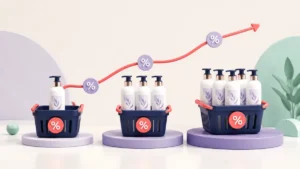
A customer who buys one unit and a customer who buys five units don’t necessarily have to pay the same amount per unit. Quantity breaks motivate customers to move between tiers.
Here is an example:
The customer saves on the per-unit price, while the merchant receives a bulk purchase order.
Quantity break converts a customer query from “Do I need it?” to “As I have to purchase one anyway, why not get three and save some money?” This strategy works well with goods that consumers are used to purchasing in bulk.
These are:
Customers need to see value in buying more. Discounts alone are not enough to motivate customers to buy more.
Savings are not the whole deal; customers must also understand the benefit of moving to a higher level. “Buy 3 and save 10%” gives the customer an obvious incentive to buy three units, especially if they use the product frequently. This is a concrete way to raise the average order value without deep discounts.
Maintain the flow so that it can be scanned easily:

It is not about giving the biggest discount. It is about choosing one that would make people buy more while still leaving profit from the order.
Select Quantity Tiers for Higher Margins. First, look at your product economics.
Check:
If your customers usually purchase two items, three might be more reasonable than ten. Your discount tiers should reflect actual buying behavior rather than arbitrary quantities.
Both strategies will work; however, they represent the value proposition differently. The “save 15%” strategy discounts the price based on how much the customer paid for the item. The “take $10 off” strategy allows the customer to know right away how much he is going to save. When developing a discount pricing strategy, make sure it fits the product and the order volume.
Three methods can give shoppers options while keeping pricing simple.
For instance,
1 unit → 3 units → 5 units
The middle option can serve as the default choice for consumers, whereas the third option serves as an incentive for those who want more. This makes Shopify tiered discounts easier to understand and gives merchants a straightforward way to structure their bundle discounts.
When setting up a Shopify bundle discount, start by thinking about your margins first. If your cost of production is $10, while your selling price is $20, you will not be able to analyze the discount based on the selling price. You should also account for the transaction costs, fulfillment, shipping, return costs, and any other variable costs. This way, you get realistic limits to your pricing strategy.

A quantity-based promotion works well if there is a real reason the customer would buy more. Avoid offering tier levels just because your shop supports it.
But rather:
Handle the combination of quantity-based discounts with automatic discounts from other Shopify promotions. This way, a client eligible for several discounts could get more than you intended. Also, keep in mind that clear communication matters. When a client sees “Buy 5, save 20%”, they don’t know whether the discount is automatic. You also need to consider your ecommerce profit margin.

Once you’ve chosen your product and quantity, BundleSuite provides a solution to implement your strategy.
In terms of practicality, the set-up will be made up of five components:
BundleSuite provides product bundles and various bundling techniques such as:
For those who already use product bundling, quantity offers will complement other bundle techniques depending on the product and shopping behavior. The initial value should be realistic. For example, if there is a smooth progression from one to three units, this will show that your stage is functioning properly. However, if not many make it up to five, then the threshold needs to be revised. This makes product bundling a more effective merchandising technique than a one-time promotion.

Shopify quantity breaks allow order sizes to grow because they make quantities more valuable without compelling the merchant to offer large discounts. The best promotions feature easy-to-understand tiered structures, reasonable quantities, and discounts that still leave room for margin. Structure the promotion, monitor customer reactions, and fine-tune the promotion accordingly.
What I love about BundleSuiite is the SEO impact. Each bundle has its own product page, which helps with marketing and driving organic traffic! This has opened up new opportunities for me to promote specific bundles and get them ranked on Google. The app is fast, flexible, and customer support is top-notch. My bundle sales have increased dramatically since I installed it.
Quantity breaks are the pricing reductions that rely on the volume of goods bought by the client.
Quantity breaks give people an economic incentive to buy more items. As the client enters another tier of the offer, Shopify AOV will be boosted.
You don’t need more than three tiers for a quantity discount offer. You need to find quantities that suit your products and clients.
Firstly, you should find out the product and fulfillment costs. Then, you should establish the maximum discount that will not harm your margins. Avoid unrealistic quantities and discounts.
Yes. Quantity-based pricing can complement product bundles if there is a strong reason for people to buy more items.
BundleSuite can help merchants create product bundles and offers that encourage people to buy more items.
Your email address will not be published. Required fields are marked*