10 min read
Jun 09, 2026
Too many choices kill sales. Not because customers don’t want options — they say they do — but because the mental cost of evaluating options eventually outweighs the desire to buy anything at all. This is decision fatigue, and it’s one of the quieter conversion killers in ecommerce.
A store may have 200 different SKUs, a customer can filter through those products for 10 minutes by clicking on 6 product detail pages but they will leave the store empty handed. The reason they left the store with nothing is not because of fit, but rather that the effort involved with choosing was too great. Product bundles eliminate the effort to choose.
An ideal bundle offers the customer a predefined set of complementary products that are available at predetermined price points and provides a reason why the customer should purchase that bundle. This is not manipulation; it is curation of products into bundles. This piece covers what decision fatigue actually does to ecommerce performance, why your catalog size might be working against you, how bundling products restructures the purchase decision, the psychology that makes bundles convert, and which bundle formats do the heaviest lifting when it comes to simplifying the shopping experience.
6 things worth knowing before you keep reading:
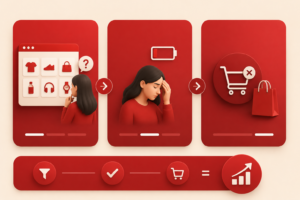
The term comes from psychology, not retail. The original research looked at judges making parole decisions — their rulings became measurably harsher as the day went on, not because the cases were different but because the mental energy required to make good decisions depletes over time. The same mechanism operates in online shopping behavior, just with lower stakes and a back button.
Decision fatigue in ecommerce shows up in a few specific ways. Cart abandonment after a long browsing session. High bounce rates on collection pages with too many filters. Customers who email asking “which one should I get?” — which sounds like engagement but is actually a signal that your store failed to answer that question on its own.
Choice overload is the upstream problem. When every product page looks equally valid and the differences between options aren’t immediately clear, the cognitive cost of choosing rises fast. Customers don’t consciously think “I’m experiencing decision fatigue.” They just feel tired of the page and close the tab. Ecommerce performance suffers quietly as a result — you see the drop-off in analytics but not the reason behind it.
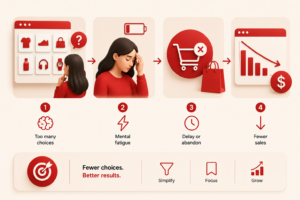
The counterintuitive truth about catalog size is that more products don’t mean more sales. Past a certain point, they mean fewer. The famous jam study — where a tasting table with 24 jams attracted more browsers but sold far less than a table with 6 — has been replicated enough times across enough contexts that the pattern is reliable: choice overload reduces purchase rates even when customers claim they prefer having options.
This is evident throughout the Shopify sales ecosystem through collection pages that are designed well but paralyze the shopper with too many options available to them via functionality. This results in forty variants of the same product, eight sizes for the same dietary supplement, and seventeen different colour options for a bag of products each micro-decision made by the customer will accumulate quickly; therefore, once a shopper filters and compares three products (and reads three product description), they will have utilised more mental resources than originally planned to in their shopping trip.
Bundling products addresses this structurally. Instead of asking the customer to build their own solution from components, you present a complete one. The shopping experience shifts from “what do I need?” to “does this fit what I need?” — which is a much easier question to answer. Ecommerce personalization that surfaces the right bundle for the right customer at the right point in the journey takes this further, reducing the field of options to essentially one well-matched recommendation.
Bundling of products also changes the competitive frame. A customer comparing individual products across two brands is doing a lot of work. A customer comparing a bundle to a competitor’s bundle is doing far less — and the brand that’s packaged its offer more clearly tends to win that comparison.
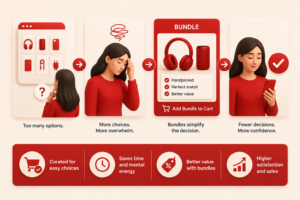
Structural changes lead to simplifications. When a customer goes from looking through separate products, to looking at a bundle of products, a binary comparison needs to occur: Does this bundle meet my needs? Yes or No?
When looking at a bundle (even if the bundle contains five different individual items), only one comparison is needed to determine if the bundle meets a customer’s needs, rather than making five separate comparisons to determine if each individual item meets the customer’s needs. The compatibility and complementarity of each individual item to the bundle has already been determined, so less work will be required by the customer.
Perceived value rises without the price necessarily dropping – A bundle priced at £80 that contains three products individually worth £100 creates a stronger sense of value than a 20% discount on any one of those products alone. Bundle pricing that’s anchored to individual product prices makes the saving feel concrete rather than arbitrary. Perceived value is doing more work here than the actual discount — customers feel like they’re getting something curated for them, not just marked down.
Ecommerce personalization becomes more achievable – Recommending one bundle to a customer based on their browsing history or previous purchase is a simpler personalisation task than recommending individual products across a full catalog. And for the customer, receiving one well-matched recommendation feels more useful than a carousel of loosely related items.
By offering bundled packages, businesses create less hesitation in consumers over whether they are making the correct decision by waiting for future sales. Bundles have greater perceived value than individual items as opposed to being an impulsive decision and will result in an increased level of comfort when immersing oneself into this type of transaction.
Consumer psychology explains bundle performance in ways that pure pricing logic doesn’t.
Product recommendations framed as bundles convert better than the same products presented as a list. The framing signals that someone — the brand — has already done the thinking. Customers trust curation. They’re more sceptical of algorithmic lists labeled “you might also like.”
The term “frequently purchased together” signifies two concepts: social acceptance and relatedness; therefore it is a highly effective conversion mechanism. It provides evidence that other customers are actively looking for the same product combination as yours.
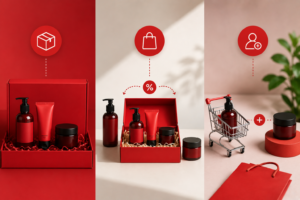
Pure bundling means the products are only available as a set — you can’t buy the components individually. This is the most aggressive simplification of choice available. The customer can’t second-guess whether they need all three items because the option to buy just one doesn’t exist. Works best for brands with strong enough category authority that customers trust the curation — and for product systems where the individual components genuinely don’t make sense in isolation.
Mixed bundling keeps individual products available while also offering a bundled version at a better price point. This is the most common format for DTC brands because it doesn’t alienate customers who have specific preferences, but it does make the bundle the path of least resistance. For customers experiencing choice overload, the bundle becomes the easy exit — and that’s exactly what you want it to be.
Cross-sell bundlings pair a product a customer is already buying or has already bought with a complementary item. The decision simplification here is contextual rather than categorical — instead of asking a customer to navigate a catalog, you’re presenting one additional relevant option at the moment of highest intent. Done well, it feels like ecommerce personalization. Done poorly, it feels like upselling. The difference is usually relevance.
The downstream effects of reducing decision fatigue through bundling show up in metrics that matter:
Decision fatigue is not a niche conversion problem — it’s happening in almost every ecommerce store with more than a handful of SKUs. Bundling of products is one of the most practical responses to it because it works at the product level, not just the marketing level.
Pure bundling, mixed bundling, and cross-sell bundlings each reduce choice overload in different ways, at different points in the customer journey.
The stores that get this right — that use bundle pricing, consumer psychology, and genuine product recommendations to simplify rather than overwhelm — end up with better ecommerce performance, lower abandonment, and repeat customers who came back because the first experience was easy.
That’s what good product bundling solutions actually look like in practice. Building bundles on Shopify doesn’t have to be complicated. BundleSuite handles fixed sets, mix-and-match, and cross-sell bundle formats natively — no custom dev required. Worth a look when you’re ready to simplify your customers’ buying decisions.
BundleSuite is your Shopify-ready bundle builder app for high-converting bundles—BYOB, Mix & Match, Volume Discounts, Kits, Combos, you name it.
Built for merchants who want control, flexibility, and results. BundleSuite is your Shopify-ready bundle builder app for high-converting bundles—BYOB, Mix & Match, Volume Discounts, Kits, Combos, you name it. Built for merchants who want control, flexibility, and results.
BundleSuite is your Shopify-ready bundle builder app for high-converting bundles—BYOB, Mix & Match, Volume Discounts, Kits, Combos, you name it. Built for merchants who want control, flexibility, and results.
Your email address will not be published. Required fields are marked*