6 min read
Sep 25, 2026
Once a store’s regular customers have already purchased them, basic bundles, which offer three items at a fixed discount, no longer have any effect on increasing revenue. Advanced bundling strategies are effective since they align the bundle format with the way a particular customer wishes to shop, rather than simply aiming to move inventory. It is essential to get this aspect right if a bundle program is to continue generating increasing revenue rather than leveling off after the first few months.
Key Takeaways
The flat “buy three, save 10%” bundle attracts customers who were already planning to purchase several items. After this group has been converted, the bundle ceases to target any new customers, and as a result, the Shopify average order value reaches a plateau even though the bundle remains in operation. This is the point at which a static product bundling strategy hits its limit: it was never designed to respond to different shopper intentions, merely to apply a single discount rule to all customers.
To go beyond this, product bundling should be regarded as consisting of a number of separate formats rather than as a single offering. Different product bundling strategies are suited to different stages in the customer journey, since someone who is browsing without having a clear idea shops in a different way from someone who already knows precisely what they want, and a single bundle format cannot adequately serve both of them.

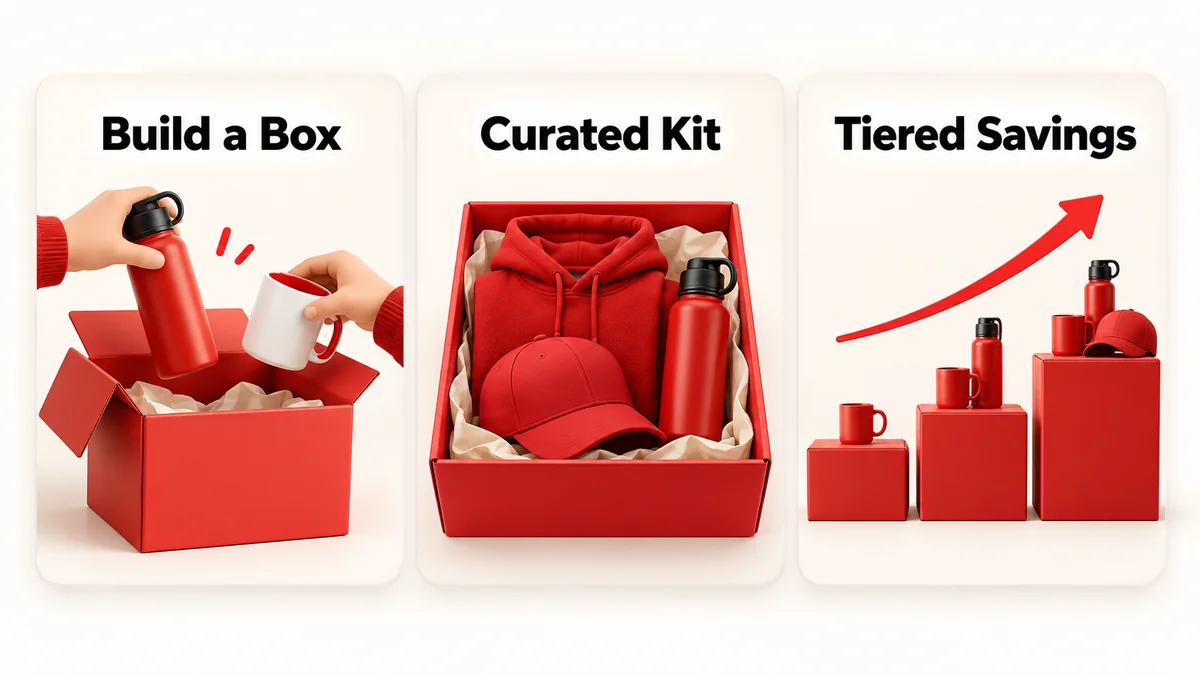
The build-a-box format allows customers to select their own items within a certain price or quantity range. Shopify’s build-a-box arrangements are most suitable for customers at the browsing stage who want control over the exact combination, and they always increase order value since customers add more items when they are choosing rather than when they accept a fixed set.
If you use a Shopify ‘build your own bundle’ tool which supports various product categories and quantity rules, you can offer more complex combinations than a simple three-item combo. This type of setup is appropriate for stores that have a broad range of products since the useful combinations aren’t immediately clear without some guidance; the Shopify mix and match bundle option provides customers with that guidance while at the same time keeping some choice open.
For customers who want to make a quick decision, pre-built custom bundles that are based on a specific use case perform better than open-ended builders. Product kits that are put together by the store, not by the customer, are effective when the aim is speed and confidence rather than personalization.
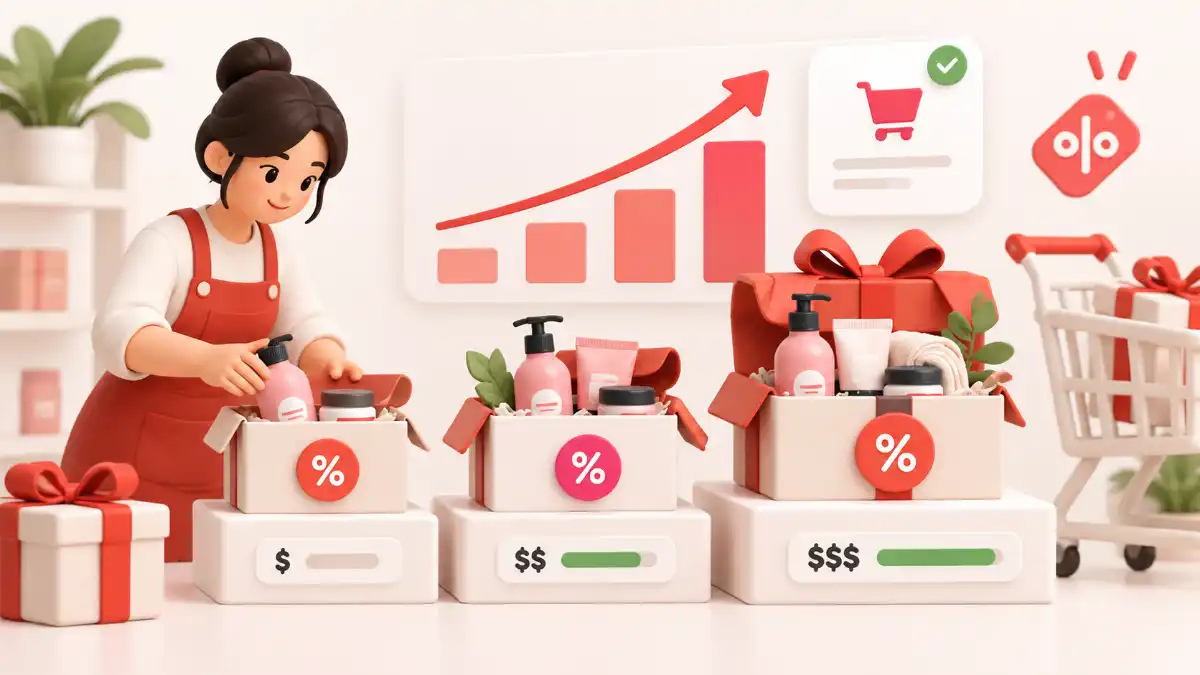
1. Encourage customers to buy larger bundles – By offering tiered incentives, which provide a greater discount as the quantity increases, the company gets customers to move towards the next price level rather than settling for the smallest bundle size. Tiered pricing is effective since it makes the next item seem as if it is costing less than it really is when compared to the discount that has already been obtained.
2. You can combine bundle offers with buy-one-get-one deals and free gifts – If you add a buy-one-get-one deal onto a bundle or provide a free gift when spending above a certain threshold, value is created without reducing the main price, thereby better protecting the margin than a simple discount.
3. Select the appropriate bundle pricing model – Since bundle pricing can be arranged on a flat discount basis, on a tiered basis, or with a fixed bundle price regardless of the individual cost of the items. The choice between bundle pricing and the bundle pricing strategy should be based on the model that helps to protect the margin for your particular product mix, as volume discounts that are suitable for low-cost items can subtly reduce the margin on more expensive items.
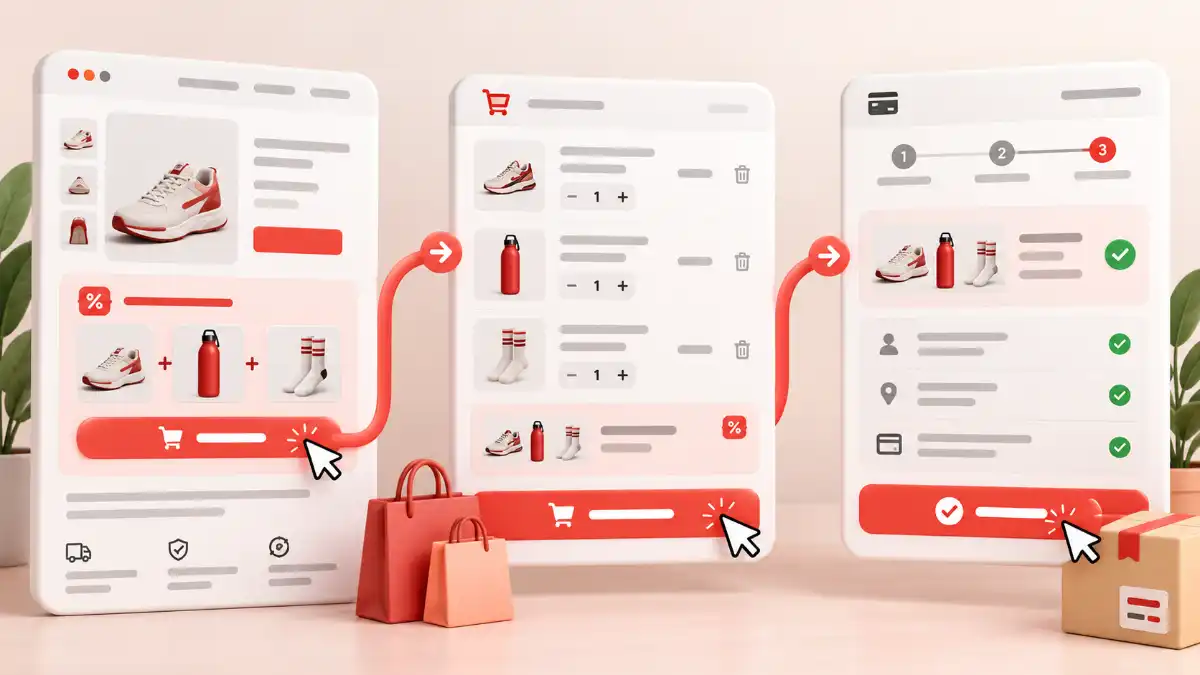
A bundle which is only displayed on its own product page fails to capture most of the instances when customers are actually deciding which product to purchase. On the other hand, the frequently bought together modules on individual product pages attract customers who have already decided on one item and are considering adding others. The ‘frequently bought together’ placements on Shopify work well because they appear at the time when customers’ intent is highest, that is, right when someone is about to add an item to their cart.
The way in which the style of placement is applied to complementary items that aren’t obviously related when looked at on paper but do make sense when used together is the same. Product bundles, Shopify product bundles, and Shopify bundles placed at these decision points always perform better than the same offers which are hidden on a separate bundles page that customers have to search for.

For most Shopify teams it would be unrealistic to set up bundle offerings, tiered pricing, and frequently bought-together product placements all by hand. A special Shopify bundle app is needed since it manages the logic and inventory syncing something done manually cannot keep up with. Tools such as BundleSuite allow a store to run several bundle types together, and a good Shopify bundle builder ensures that the real-time inventory sync is accurate across all the formats so that stock problems won’t cancel out the revenue increases. Because of this, the app is continually rated as one of the best Shopify bundle apps for exactly this reason: it includes all the various advanced formats rather than just offering one.
What I love about BundleSuite is the SEO impact. Each bundle has its own product page, which helps with marketing and driving organic traffic! This has opened up new opportunities for me to promote specific bundles and get them ranked on Google. The app is fast, flexible, and customer support is top-notch. My bundle sales have increased dramatically since I installed it.
When the average order value from the existing bundles levels off for a number of months in a row, it means that the present format has taken advantage of all the easy opportunities and now requires more variety.
With build-a-box, the customer can select their own items provided that certain rules are followed, whereas a standard combo is a pre-determined collection of products which the store has already decided should be offered together.
It quickly becomes impossible to handle more than one or two bundle formats manually using Shopify’s theme editor, which is why most stores end up needing a dedicated app when they go beyond simple bundling.
Instead, test the flat discount rates, the tiered pricing, and the fixed bundle pricing based on your actual margin data rather than assuming that one pricing model will work for the entire catalog.
Individual product pages, cart pages, and checkout are the highest-intent moments to place bundle offers, since customers there have already committed to buying something.
Your email address will not be published. Required fields are marked*