
10 min read
Jun 12, 2026
Most ecommerce conversations about growth start with traffic. More ads, more influencers, more SEO. What gets less airtime is the question of whether the revenue coming from that traffic is actually returning what the spend deserves. eCommerce ROI is the number that answers that — and for a significant portion of Shopify stores, it’s worse than the top-line revenue figures suggest. High gross revenue with thin margins, high ad spend with low repeat purchase rates, high conversion rates on low-value orders. The math doesn’t always flatter the business once you run it properly.
This article explains what ROI ecommerce is actually measuring, methods for accurately calculating this metric without over-simplifying, strategies for effectively increasing this metric, and the ecommerce challenges that complicate accurate measurement. Additionally, this article discusses the tools that help to narrow the gap between how much you’re spending and how much you’re really seeing in return.
6 things worth knowing before you keep reading:

ROI ecommerce is the ratio of net profit generated from your ecommerce operation to the total cost of running it. In its simplest form:
ROI = (Net Profit ÷ Total Investment) × 100
But the “total investment” part is where most calculations get loose. Ad spend is easy to include. Developer costs, app subscriptions, fulfillment overhead, customer service time, return processing — these are harder to track but just as real. An ecommerce profit calculator that only inputs ad spend against revenue is measuring marketing ROI, not business ROI. Those are related but not the same thing.
Return on investment meaning in an ecommerce context also has to account for time horizon. A customer acquired at a loss who becomes a high-repeat buyer has a positive ROI over 12 months and a negative one over 30 days. The same customer, different conclusion, depending on when you measure.
B2B ecommerce ROI adds another layer: sales cycles are longer, order values are higher, and the relationship between a single transaction and total customer value is even more pronounced. A B2B e-commerce ROI calculator needs to weight lifetime value far more heavily than a D2C equivalent.
Returns in ecommerce are the figure most stores leave out of their ROI calculation and shouldn’t. A product sold and returned hasn’t generated revenue — it’s generated a transaction, a logistics cost, and a potential resale problem. Ecommerce return rate at 15-20% (common in apparel and electronics) changes the ROI picture materially.
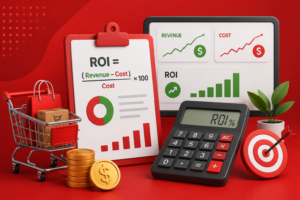
The cleaner the inputs, the more useful the output. Here’s a framework that accounts for the variables most calculations miss:
Begin by taking total sales revenue and taking out total returns and refunds, your discount codes or promotional spend, all payment processing costs and any revenue that you can’t verify from your channels (e.g., direct traffic without attribution would not be accurate).
Add up: paid media spend (ads, influencers, affiliates), platform fees (Shopify subscription, app costs), fulfillment and shipping costs, customer service overhead, content and creative production, and any technology or development spend. For B2B ecommerce ROI calculations, include sales team time if relevant.
(Net Revenue – Total Investment) ÷ Total Investment × 100 = ROI %
Return on invested capital calculation at the channel level — calculating ROI per acquisition channel rather than just at the business level — tells you where to allocate the next pound of spend. A paid social channel returning 180% ROI and an email channel returning 620% ROI shouldn’t receive the same budget weight. Most ecommerce strategist frameworks prioritize this channel-level breakdown over aggregate ROI precisely because it drives allocation decisions.
Average ROI ecommerce benchmarks vary widely by category: software and digital products run high (low fulfillment cost), apparel and electronics run lower (high returns, high acquisition cost). The number to optimise against is your own historical baseline, not an industry average.
Traffic growth is expensive. The strategies below lift ROI by improving what happens to the traffic you already have, or by reducing the costs that drag the number down.
Ecommerce conversion optimization is the highest-leverage ROI strategy for stores that have already validated their product-market fit. Doubling your conversion rate from 2% to 4% doubles your revenue from the same traffic — no additional ad spend required. The average ecommerce conversion rate for high ticket sales sits lower (0.5-1.5%) than commodity products (2-4%), so benchmarking correctly matters here.
Ecommerce conversion rate optimization starts with the ecommerce conversion funnel: where are customers dropping off? Homepage to collection page, collection page to product page, product page to cart, cart to checkout, checkout to purchase — each transition has a loss rate. Identify the worst-performing transition first and fix it before moving down the funnel. Tools for this include session recording, heatmaps, and A/B testing — but the insight usually starts with looking at the ecommerce conversion tracking data you already have.
Pricing has been neglected as a lever to drive ROI. Retailers typically determine their pricing and don’t alter it, yet dynamic pricing or tiered pricing (bundles, volume pricing, seasonality) can provide a significant lift to the average order value without needing to drive additional traffic or convert a higher percentage of visitors. By implementing effective ecommerce pricing strategies, such as creating a premium tier or a bundle at an anchor price, or a quantity break structure, you will change the distribution of order values across your customers, which will have a positive impact on your ROI while not altering your acquisition costs.
New customer acquisition is typically the most expensive line in an ecommerce budget. Ecommerce growth strategies that prioritise retention — repeat purchase rate, subscription conversion, loyalty mechanics — reduce the effective cost of revenue over time. A customer acquired once but retained for three years has a very different ROI profile than a customer acquired once and never seen again. Shopify marketing investment in retention channels (email, SMS, loyalty) almost always returns better ROI than equivalent spend on acquisition channels, particularly after the first year of operation.
Ecommerce return rate is a silent ROI killer that rarely gets the same strategic attention as conversion rate. A 5% reduction in returns on a £500k revenue business with a 20% return rate recovers £50k in gross revenue — with no additional acquisition spend. Strategies that reduce returns: better product photography (sets accurate expectations), clearer sizing and specification information, pre-purchase quizzes that improve product fit, and post-purchase communication that reduces buyer’s remorse before it turns into a return request.
Product bundles address two ROI levers simultaneously: they lift average order value (more revenue per transaction) and they improve retention by exposing customers to more of the product range in a single purchase. A customer who buys a bundle is more likely to come back than one who buys a single product — because the bundle expanded their relationship with the brand. Shopify bundle builder tools and the best Shopify bundles app solutions make this executable without development overhead, which means the ROI on the bundle strategy itself is high — low implementation cost, material revenue impact.
You cannot optimise what you’re not measuring correctly. Ecommerce conversion tracking gaps — missed events, attribution errors, cookie consent reducing trackable sessions — mean the data most stores are optimising against is incomplete. GA4 setup, server-side tracking for post-iOS14 accuracy, and regular audits of conversion event firing are operational hygiene items that directly affect how well every other ROI strategy performs. Conversions measured on an ecommerce website accurately is increasingly a technical question as well as an analytical one.
How to automate your ecommerce business is an ROI question as much as an efficiency one. Customer service automation (FAQ bots, order status self-service), email and SMS flow automation (abandoned cart, post-purchase, win-back), and inventory management automation all reduce the labor cost side of the ROI equation. The investment in automation tools pays back quickly when the alternative is headcount growth to handle the same volume.
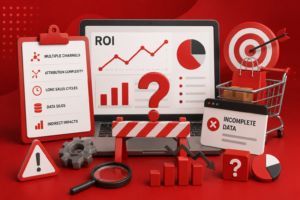
Knowing the right strategies matters less if the measurement infrastructure isn’t reliable. These are the most common ecommerce challenges in getting accurate ROI data:
eCommerce ROI is the number that tells you whether the business is actually working, not just growing. ROI strategies that focus only on acquisition — more traffic, more ads, more channels — will lift revenue but not necessarily ROI. The strategies that move the ratio: ecommerce conversion rate optimization, retention investment, return rate reduction, bundle-driven AOV growth, and tracking accuracy improvements.
For Shopify stores, the best Shopify bundles app and Shopify bundle builder tools represent one of the highest-ROI implementation decisions available — low setup cost, direct impact on average order value and retention, no development required. B2b ecommerce roi and D2C ROI follow the same logic, just at different time horizons and order values. Fix the measurement first, then optimise the levers. Everything else is working in the dark.
For Shopify stores looking to lift AOV as part of an ROI ecommerce improvement strategy, BundleSuite handles product bundling end-to-end — fixed sets, mix and match, tiered discounts — without the development overhead. One of the cleaner ROI-positive implementations available on the platform.
What I love about SimpleBundle is the SEO impact. Each bundle has its own product page, which helps with marketing and driving organic traffic! This has opened up new opportunities for me to promote specific bundles and get them ranked on Google. The app is fast, flexible, and customer support is top-notch. My bundle sales have increased dramatically since I installed it.
Event based analytics are how conversion activity is tracked. Google Analytics 4, Shopify’s built-in analytics or server-side instituting of the two serve as the platforms for event-based tracking. An event such as purchase, add to cart or checkout initiation serves as a trigger for conversion event to fire. Therefore, the reliability of this data can only be assured through the correct implementation of the event-based tracking, thus necessitating regular audits of these methods of tracking activity.
Depends heavily on category and price point. The widely cited average of 2-3% applies to mid-market D2C stores selling products under £100. High-ticket products (£500+) typically see 0.5-1.5%. Luxury and considered-purchase categories run even lower. The more useful benchmark is your own historical average — a 20% improvement on your baseline is more meaningful than hitting an industry figure.
Take on the biggest and easiest tasks first: cart abandonment flow automation, order confirmation and shipment notifications, and answering frequently asked questions (FAQs). Shopify has built-in automations for basic automations. However, when dealing with more complicated workflows — re-order inventory, post-purchase sequences based on products, and order confirmations — you will want to use dedicated tools such as Klaviyo, Gorgias, and Shopify Flow. These dedicated tools provide you with greater automation without needing to create a custom solution.
Your email address will not be published. Required fields are marked*